explico
Turn lecture notes into a course that explains itself. explico is a course engine built for writing with an AI assistant. A shared set of rules keeps everything the author and the AI write consistent. On the reader's side, every symbol explains itself, figures respond to sliders, and each chapter ends with a quiz.
Open the playground → See a full course ↗
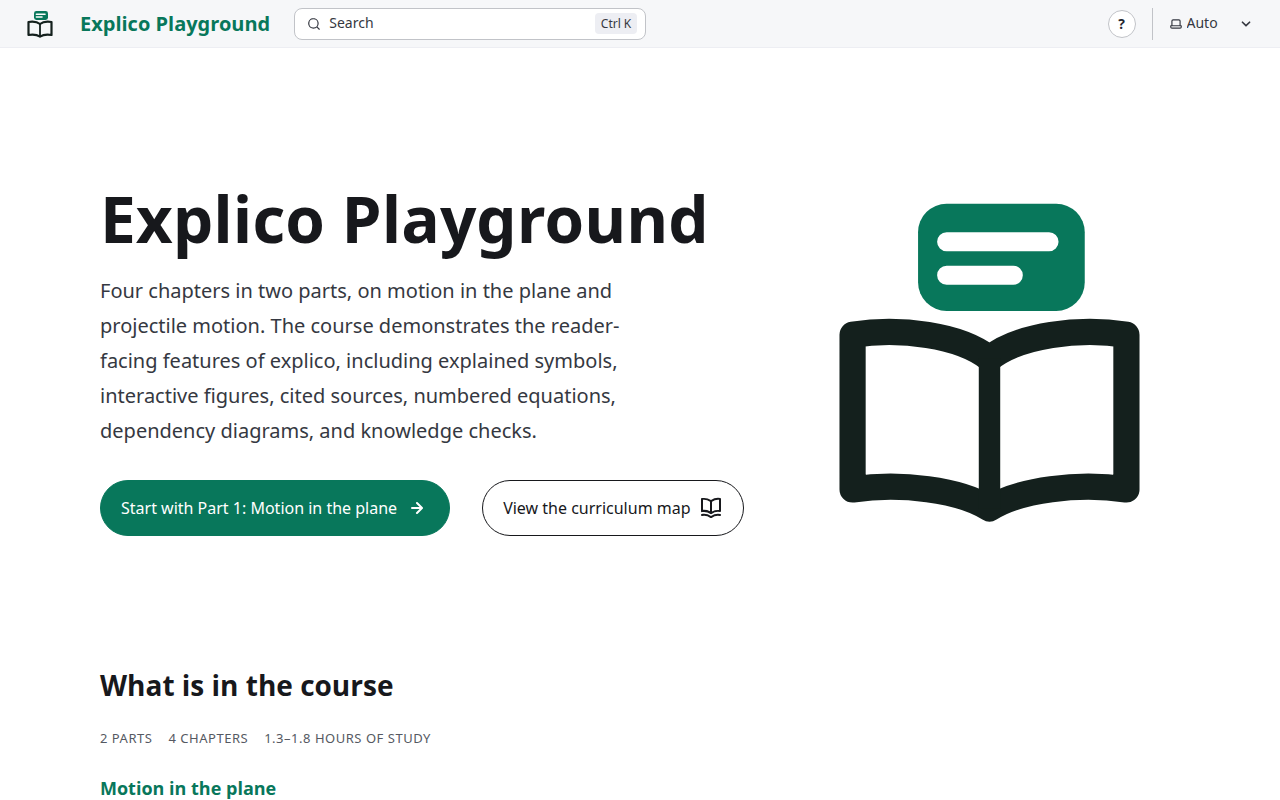
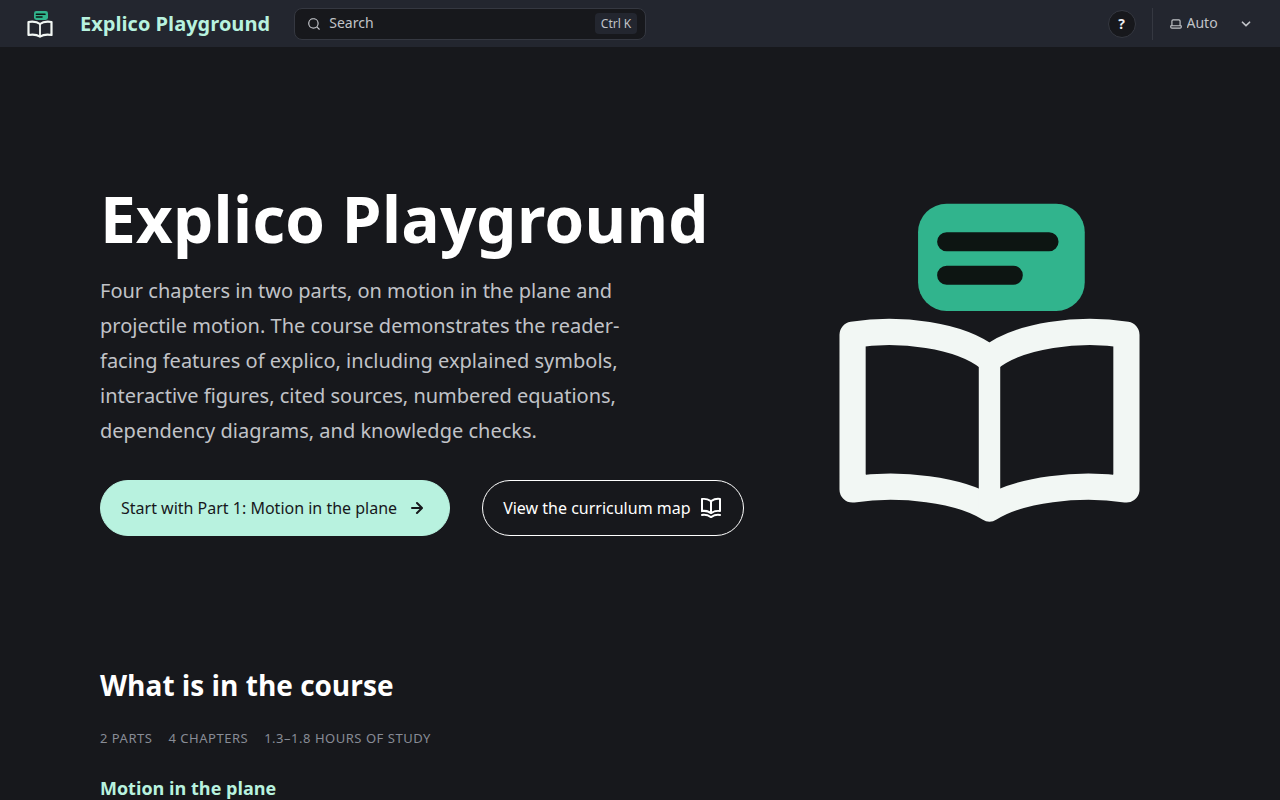
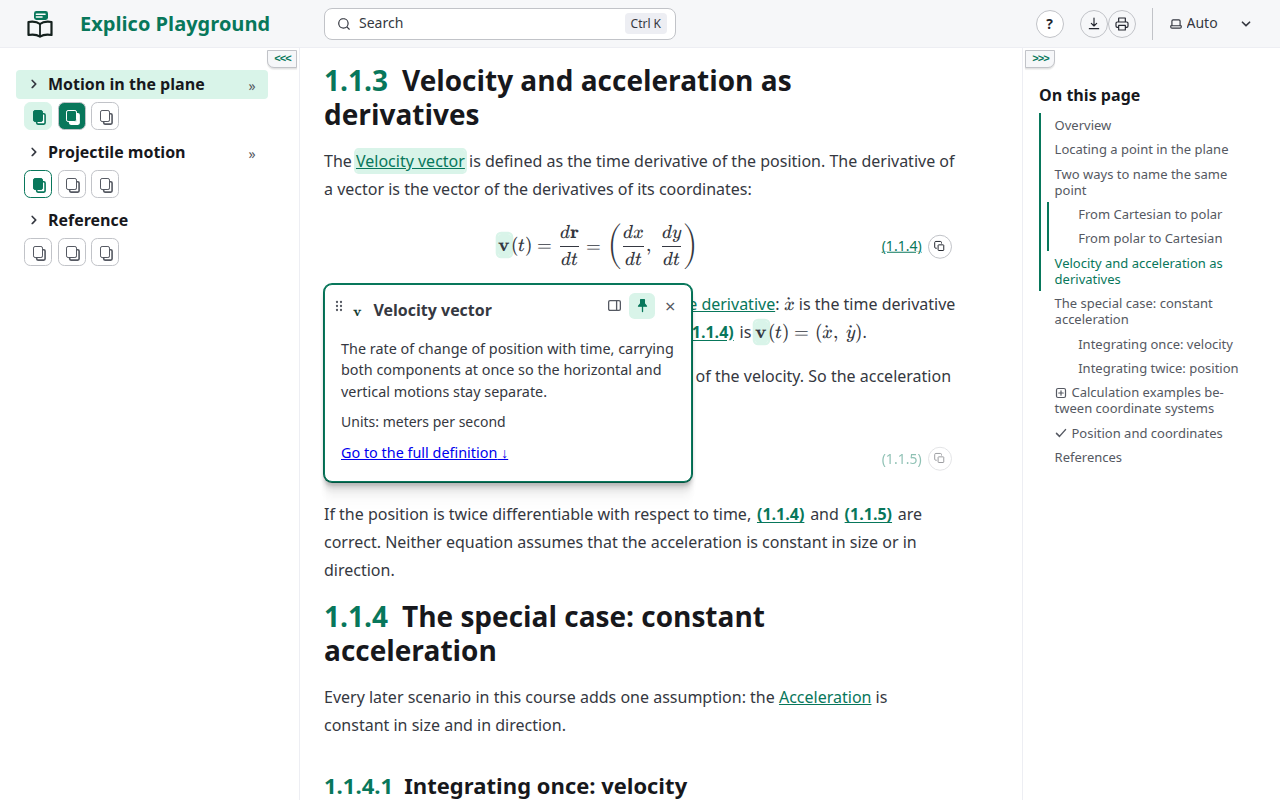
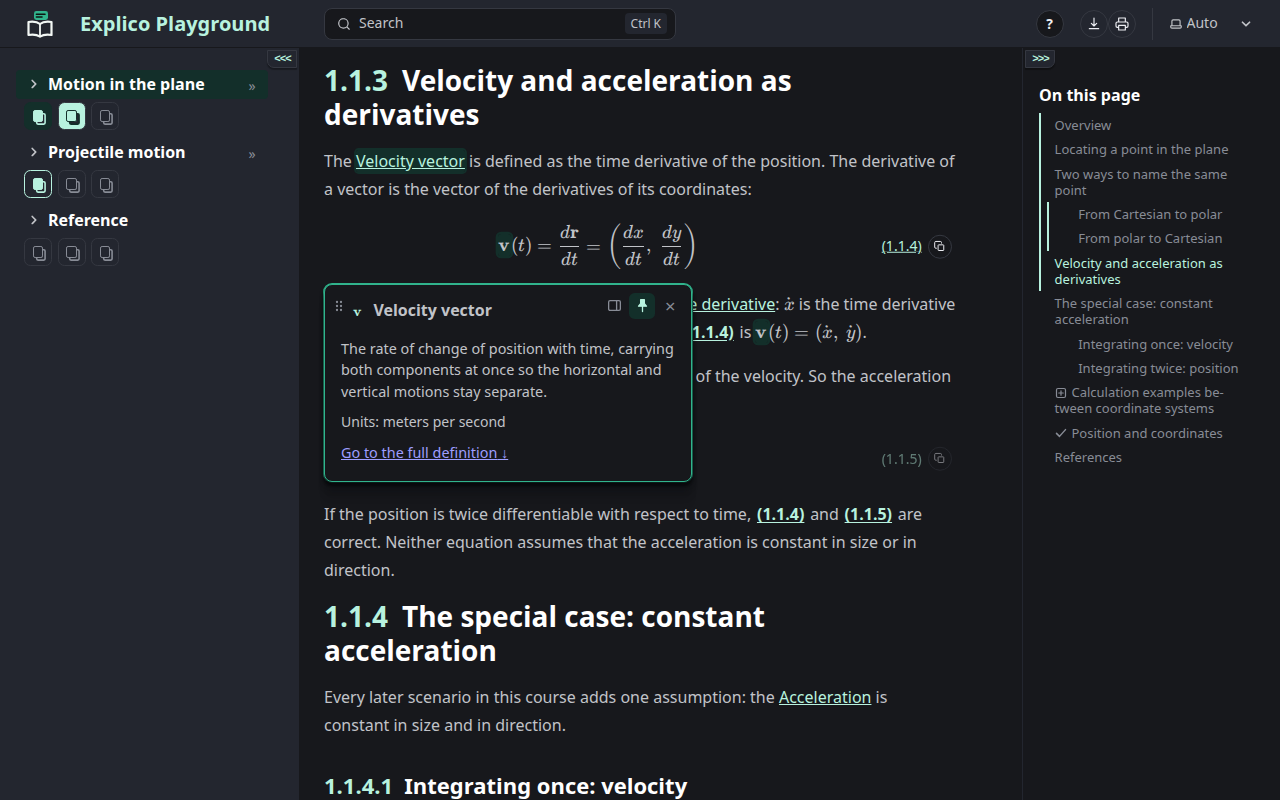
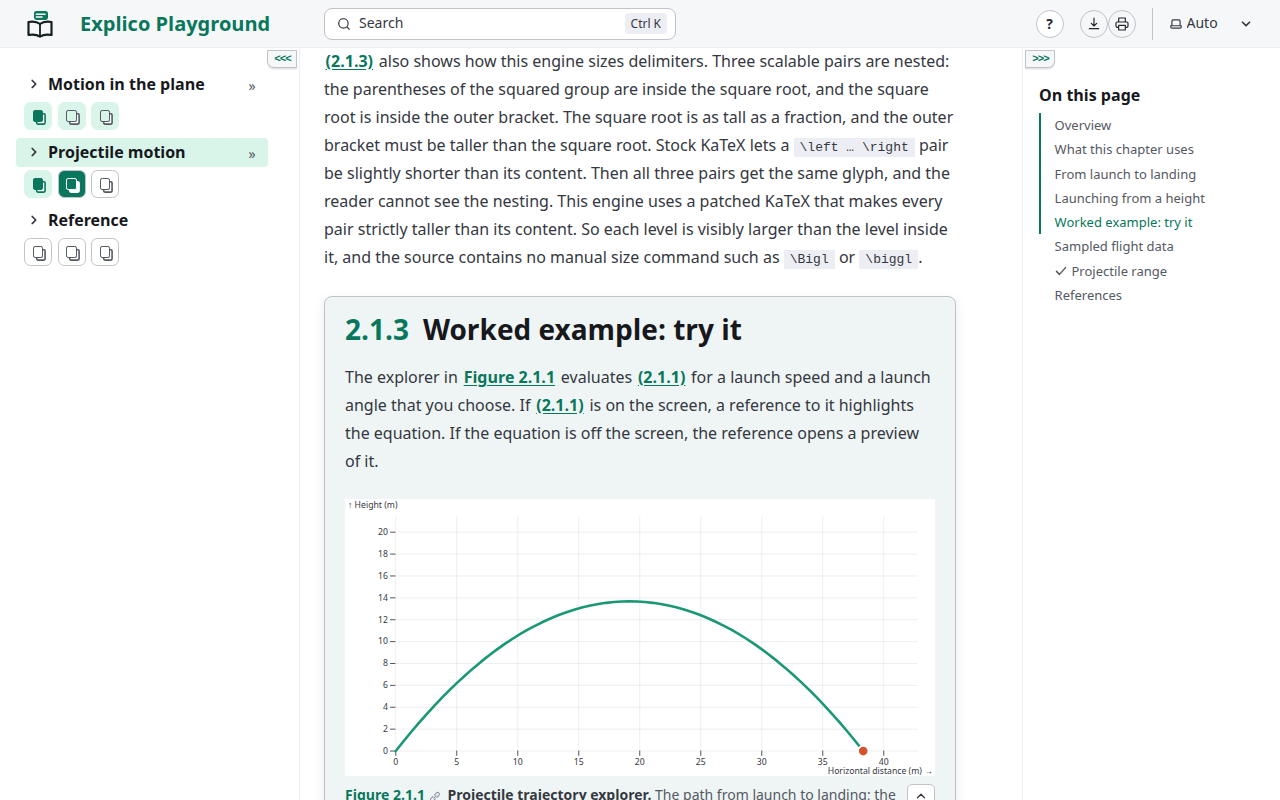
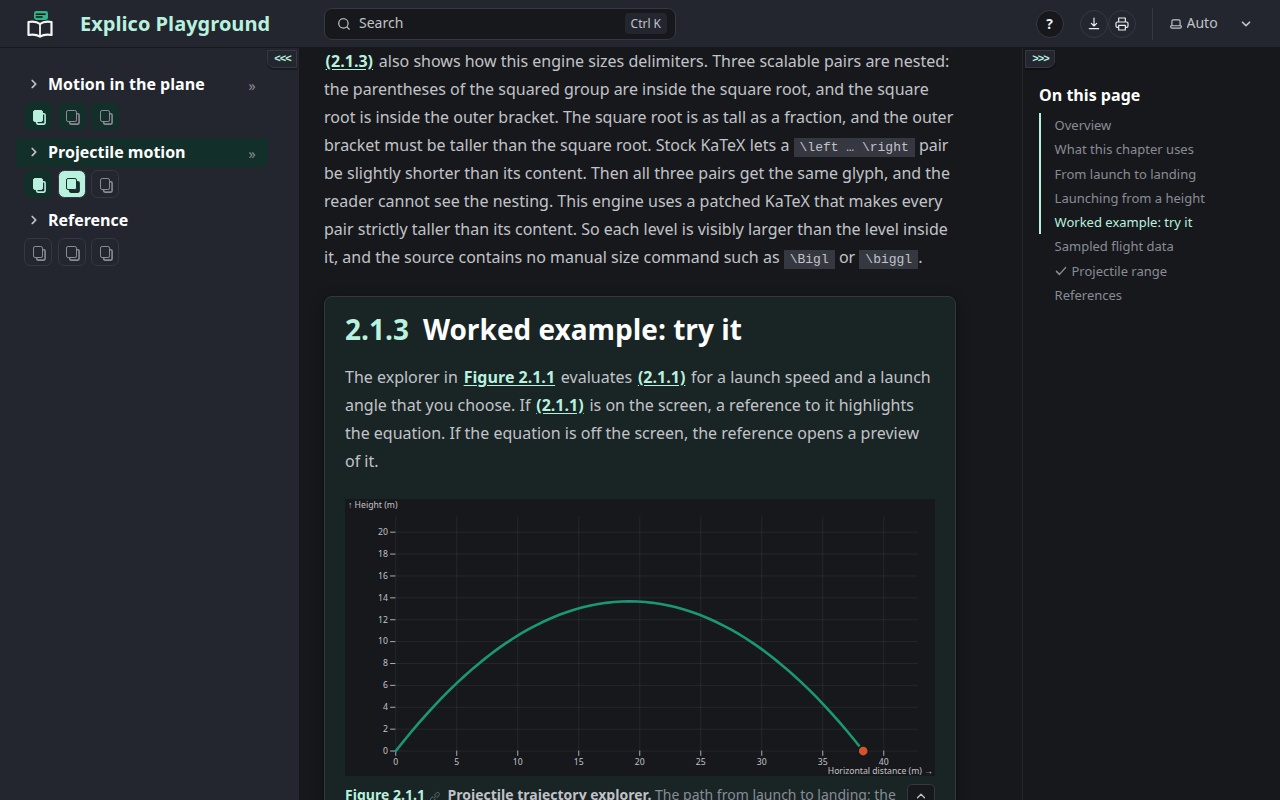
Hover a page to bring it forward in the night theme. Click to open that page in the playground. Tap a label to bring its page forward in the night theme. Tap the page to open it in the playground.
What it is for
A course is written once and read many times, by people who meet its notation for the first time. explico serves both sides:
- For the people who write it, an environment where an AI assistant does most of the drafting and a set of rules keeps the result consistent. Some rules guide the writing; others are checked on every build. The same rules make the AI's work and the author's review faster.
- For the people who read it, an interface that makes a technical topic faster and more convenient to understand. It supports sharing (a link to any passage), engagement (interactive figures), and self-testing (a quiz in every chapter).
A course does not have to start from a blank page. Existing lecture notes, documentation, and instructions are the raw material, and the AI turns them into lessons that follow the rules.
Why authors like it
- Start from what you already have. Hand the assistant your lecture notes, a manual, or a set of instructions. It drafts the lessons and you steer and review, in plain language.
- Consistency is not left to memory. About forty rules cover how symbols are written, how figures are drawn, how lessons are structured, and how sentences are worded. The assistant reads the rules before it writes, and the build checks the ones a script can check. See Authoring rules.
- Mistakes are caught before a reader sees them. A symbol nobody defined, a reference to an equation that no longer exists, or a lesson that depends on one that comes later stops the build. The build names the file and the line, so the assistant fixes it on the next pass.
- Your course, your house style. Switch a rule off, tune it, or add rules of your own in a settings form, without touching the engine.
- Readers see what changed. Every release of the course carries a knowledge version and a changelog, shown to readers in the course itself.
Why readers like it
- Every symbol explains itself. Point at a symbol, in the text or inside an equation, to see what it means and its units. Click it to keep the explanation open while you read on.
- Nothing is out of reach. Equations, tables, and figures are numbered, and a reference to one works across chapters. Pointing at the reference shows a preview, so you rarely lose your place.
- Try it, don't just read it. Interactive figures respond to sliders, and the numbers inside the rendered equation change with them.
- Check what you learned. Every chapter ends with a knowledge check.
- Share the exact spot. Every section, equation, table, and figure has its own link. A classmate who opens it lands on that spot, highlighted.
- Read it your way. Light and night themes, a print layout that keeps the page as you left it on screen, and a one-file download of any chapter for reading offline.
Two courses to read
The playground is a feature tour: four short chapters on motion in the plane and projectile motion. Every reader-facing feature of explico appears in it at least once. It is small on purpose, a test bed rather than a physics course. The playground guide lists what is in it.
credit-and-derivatives is a real, working course built on explico, at full scale: discounting and rates, bonds and bond options, credit and CDS, derivatives and options, in seven parts. It shows the engine carrying the notation load of an actual quantitative-finance course.
Learn more
- Authoring rules: how the rules are enforced, tuned in a form, and extended with a course's own.
- Under the hood: the build pipeline, what it guarantees, and how a course is set up.
- npm: npmjs.com/package/explico. The source repository is private.
explico is pre-1.0: its API can still change between minor versions, and the license is undecided.